Integrating Local & International Payment Gateways: M-Pesa, Card, and Crypto Solutions
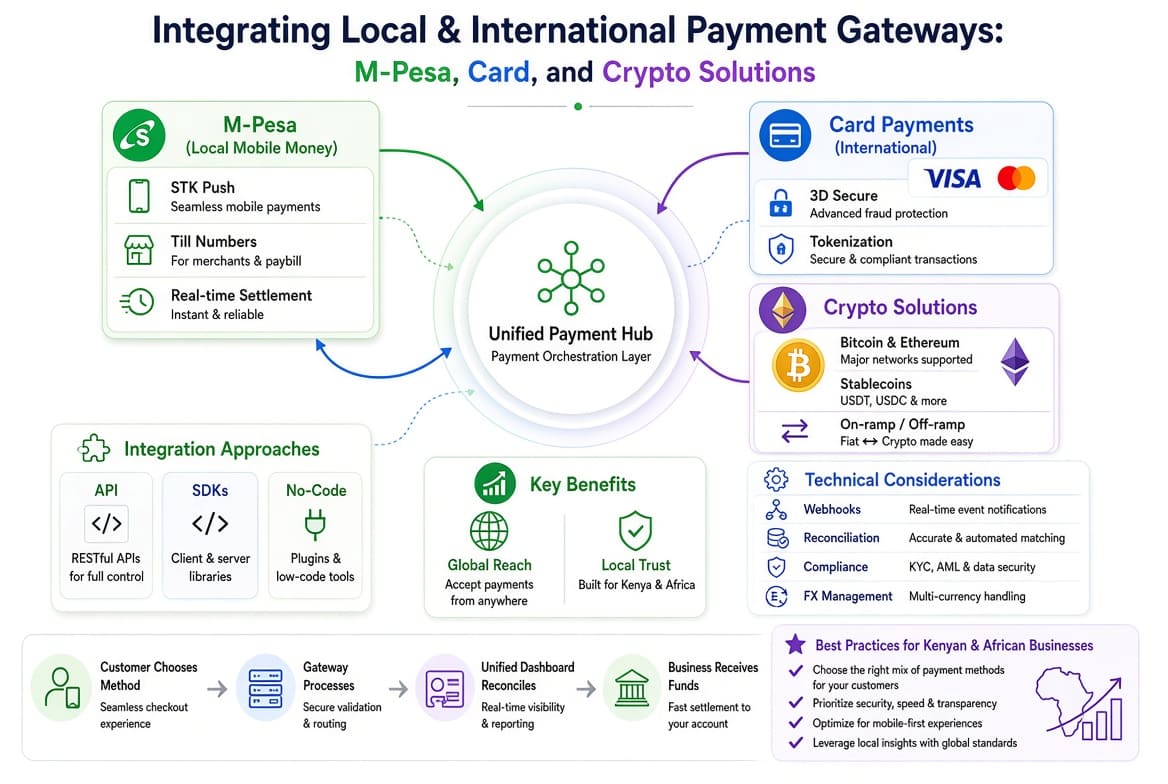
Building scalable enterprise applications often requires integrating multiple payment gateways. Accepting payments globally or regionally requires supporting local mobile money platforms (such as Safaricom M-Pesa), traditional credit card networks (Visa/Mastercard via Stripe or Checkout.com), and decentralized crypto networks (USDC/USDT).
Designing a unified, fault-tolerant payment architecture requires abstracting gateway integrations into a reliable, maintainable payment processing system.
1. Gateway Architectural Abstraction
Never hardcode specific payment gateway logic directly into core application business routines. Instead, implement a Unified Payment Interface (Factory Pattern). This structure decouples your core order, checkout, and subscription workflows from the underlying payment providers.
                               ┌────────────────────────────────┐
                               │  Core Checkout Engine / Logic  │
                               └───────────────┬────────────────┘
                                               │
                               ┌───────────────▼────────────────┐
                               │ Unified Gateway Interface Class│
                               └───────────────┬────────────────┘
                                               │
               ┌───────────────────────────────┼───────────────────────────────┐
               │                               │                               │
┌──────────────▼───────────────┐┌──────────────▼───────────────┐┌──────────────▼───────────────┐
│  M-Pesa Express Provider     ││   Stripe / Card Provider     ││ Crypto (USDC) Provider        │
│  (REST API / Webhooks)       ││   (PCI-DSS SDKs / Tokens)    ││ (Web3 RPC / On-Chain Sync)   │
└──────────────────────────────┘└──────────────────────────────┘└───────────────────────────────┘
By abstracting payment providers behind a single interface, you can route transactions based on region or fee structures, add new providers easily, and gracefully handle fallback scenarios if an upstream gateway goes down.
2. Deep-Dive Integration Architectures
1. Mobile Money Integration (Safaricom M-Pesa Express / Daraja API)
Mobile money payments rely heavily on asynchronous, push-notification checkout prompts sent directly to a user's mobile device.
- Transaction Flow: Your server issues an HTTP
POSTrequest invoking the STK Push (LIPA NA M-PESA ONLINE) API endpoint. The customer receives a prompt on their phone requesting their authorization PIN. Once entered, M-Pesa processes the request and sends an asynchronous callback payload to your registered webhook URL. - Handling Network Timeouts: Mobile network latency can cause the client-side checkout modal to time out before the M-Pesa callback arrives. Avoid marking transactions as failed purely based on client-side timeouts. Instead, implement backend polling using M-Pesa's
Transaction Status QueryAPI to verify payment state before updating the order status.
2. Credit Card Gateway Integration (Stripe / Checkout.com)
Handling credit card details directly exposes platforms to extensive PCI-DSS Compliance requirements.
- Tokenization Strategy: Never pass raw 16-digit card numbers (PANs) or CVVs directly to your backend application servers. Use client-side JavaScript SDKs provided by payment processors (such as Stripe Elements) to capture sensitive card details inside secure, sandboxed iframes.
- The provider returns a secure token or payment intent ID (e.g.,
tok_1N...) to your frontend application. Your backend then uses this token to capture funds via server-to-server API calls, completely isolating your core infrastructure from handling sensitive cardholder data.
3. Cryptocurrency & Stablecoin Integrations (USDC / USDT)
Integrating stablecoins provides instant global settlement with lower processing fees, making it an attractive option for cross-border transactions.
- On-Chain Settlement Verification: Use specialized payment gateways like Coinbase Commerce or Helipay, or monitor blockchain networks directly via JSON-RPC nodes (such as Alchemy or QuickNode).
- Generate a unique temporary deposit address or memo identifier for each order.
- Monitor network transactions for incoming transfers matching the exact order amount. Mark the checkout as completed once the transaction achieves the required network confirmation depth (e.g., 12 block confirmations on Ethereum, or 1 on Solana).
3. Webhook Architecture and Idempotency Guarantees
Because payment processing happens asynchronously, payment processors use webhooks to notify your server when a transaction succeeds or fails. Because networks are inherently unreliable, payment providers frequently resend identical webhook payloads to ensure delivery.
Your webhook handlers must be idempotent. An idempotent endpoint can receive the exact same webhook payload multiple times without causing duplicate fulfillment, double account funding, or duplicate inventory deductions.
┌────────────────────────────────────────────────────────────────────────┐
│                   IDEMPOTENT WEBHOOK HANDLING FLOW                     │
├────────────────────────────────────────────────────────────────────────┤
│ 1. Webhook Arrives ──► Verify Cryptographic Signature / Secret Header  │
│ 2. Read Payload ID ──► Check Redis / Database for Existing Process Key │
│ 3. IF Key Exists   ──► Return HTTP 200 OK Immediately (Bypass Execution)│
│ 4. IF Key Missing  ──► Save Key in DB ──► Process Transaction Logic   │
│ 5. Transaction OK  ──► Commit DB State  ──► Return HTTP 200 OK Response │
└────────────────────────────────────────────────────────────────────────┘
Webhook Processing Rules:
- Verify Signatures First: Validate the SHA-256 HMAC cryptographic signature sent in the request header against your secret endpoint key to block forged payloads.
- Process Webhooks Asynchronously: Do not run heavy processing tasks (e.g., sending emails, generating PDFs) directly within the webhook HTTP thread. Save the event payload to a queue (such as Redis/BullMQ), respond immediately with
HTTP 200 OK, and let background worker processes handle the actual fulfillment tasks.
4. Multi-Currency Accounting and Reconciliation Strategies
Operating across local and international payment systems requires tracking currency conversions, handling processing fees, and maintaining accurate financial ledgers.
- Immutable Double-Entry Ledger System: Record every payment event using double-entry bookkeeping logic within your database. Never update account balances using simple raw SQL updates (
SET balance = balance amount). Instead, record immutable transaction entries containing debit and credit legs alongside their original currency, applied exchange rate, and provider transaction IDs. - Automated Daily Reconciliation Jobs: Run automated scheduled scripts to pull settled batch reports from your payment providers (M-Pesa, Stripe, Crypto gateways) and reconcile them against internal database records. Flag any discrepancies in fees or missing transactions for internal audit teams.
Related Articles