SEO Checklist for Kenyan Businesses: The Complete Playbook for High Search Rankings
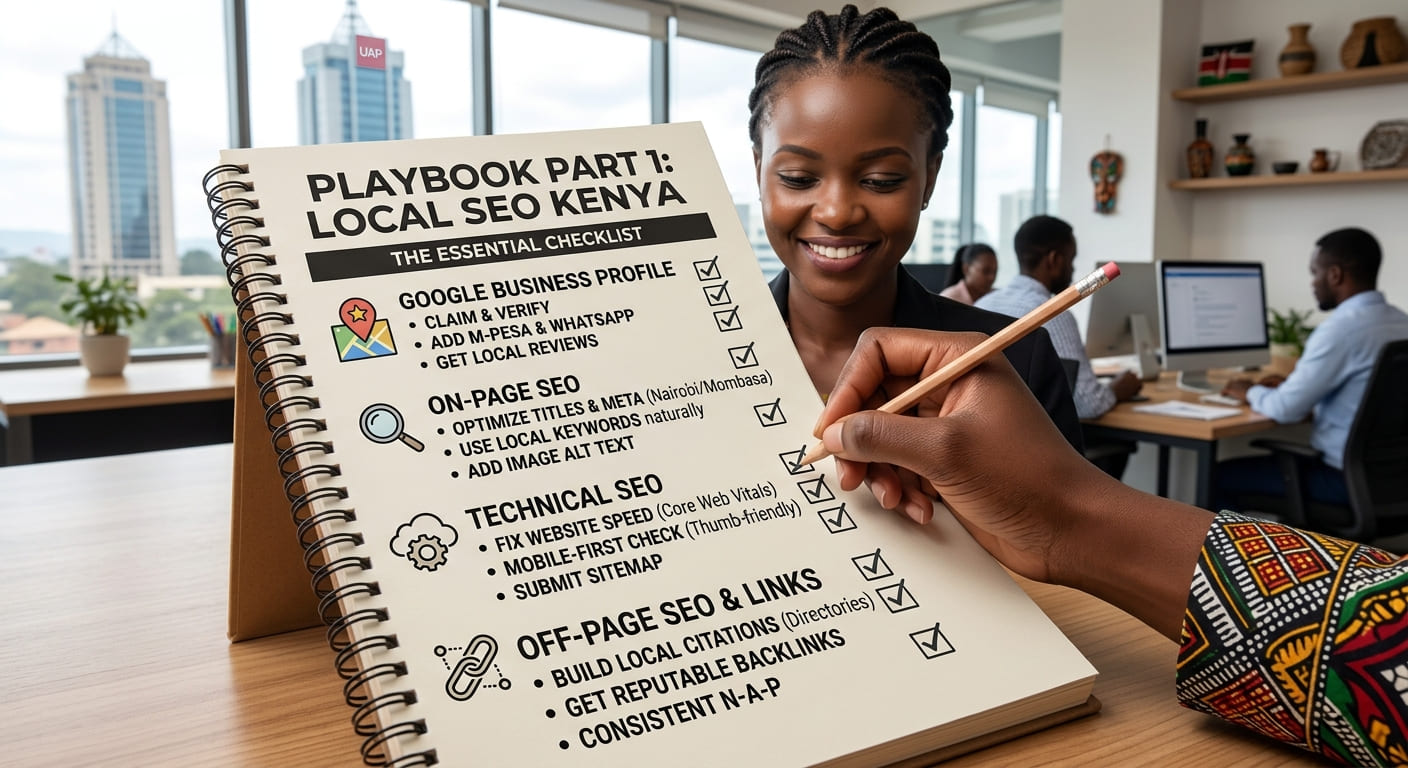
Rankings on search engines do not happen by chance. When someone searches Google decides which business gets that high-intent customer.
If your website isn't optimized properly, those potential buyers go straight to your competitors.
Whether you run a B2B agency, an e-commerce shop shipping countrywide, or a service business, this complete step-by-step checklist covers every critical pillar to get your website indexed, ranked, and visible on Page 1.
Step 1: Technical Setup & Google Search Console Integration
Before optimizing content or building backlinks, you must ensure search engines can properly discover, crawl, and index your website. Skipping technical verification means your pages may never enter Google's database in the first place.
- Set Up and Verify Google Search Console (GSC): Search Console is your direct communication line with Google. Verify ownership using Domain DNS TXT records or HTML file upload to ensure full domain coverage across both
http://,https://,www, and non-wwwversions. - Generate and Submit Your XML Sitemap: An XML sitemap guides Google’s crawlers directly to your most important URLs. Ensure your sitemap dynamically updates whenever new posts or pages are created, and submit the exact URL path (e.g.,
[https://yourdomain.co.ke/sitemap.xml](https://yourdomain.co.ke/sitemap.xml)) directly inside GSC under the Sitemaps tab. - Inspect URL Indexing and Fix Crawl Errors: Use the URL Inspection tool in Search Console to verify that your pages are indexed. Keep a close eye on the Pages coverage report to fix 404 errors, canonical misconfigurations, or pages blocked by
robots.txtfiles. - Monitor Search Performance and Queries: GSC provides exact data on what terms Kenyans are typing to reach your site. Track your total impressions, average click-through rate (CTR), and positional movement for high-intent business terms.
Step 2: Claim and Optimize Your Google Business Profile
For local search visibility in Kenya, your Google Business Profile (GBP) is as critical as your primary website. It powers your appearance on Google Maps and drives direct calls and WhatsApp messages.
- Complete the Video Verification Correctly: Google has largely moved away from sending physical postcard codes via postal mail in Kenya. Prepare for video verification by filming a single, continuous shot showing the street sign or building entrance, unlocking your office door, and showing your equipment or stock.
- Maintain 100% NAP Consistency: Ensure your Name, Address, and Phone number are identical across your website footer, Google profile, social media accounts, and local business directories. A discrepancy as simple as writing "Building, 3rd Floor" on one page and "3rd Flr" on another can split your trust signals.
- Set Strategic Service Areas and Categories: Do not just pick a generic primary category. If you run a legal firm specializing in commercial law, select "Law Firm" as your primary category, but explicitly add secondary categories like "Corporate Lawyer" or "Conveyancing Attorney". List specific estates or regions you serve, such as Kilimani, Upper Hill, Parklands, or Karen.
- Drive and Answer Google Reviews: High star ratings and review velocity directly push your profile up the Google 3-Pack. Send happy clients a direct review link right after completing a project. Always respond to every review using primary keywords naturally.
Step 3: Conduct Intent-Driven Local Keyword Research
Kenyan search habits differ significantly from Western markets. Most buyers use localized terms, neighborhood markers, and immediate operational queries.
- Target High-Intent Neighborhood and Suburb Keywords: Instead of aiming solely for short-head keywords like "plumbing services," build out specific landing pages for "plumbing services in Kilimani" or "office furniture suppliers Industrial Area".
- Include Payment and Delivery Terms: Search queries often reflect operational expectations. Keywords like "pay on delivery electronics Nairobi," "M-Pesa integrated online shop," or "same-day delivery Kenya" capture buyers who are ready to purchase immediately.
- Use Google Search Autosuggest for Local Nuances: Type your core service into Google alongside Kenyan modifiers like in Kenya, price in Kenya, cost per square meter Nairobi, best company for... to discover long-tail opportunities that tools often miss.
Step 4: Execute On-Page SEO Essentials
On-page SEO tells search engines precisely what your content covers and where you operate.
- Optimize Title Tags and Meta Descriptions: Keep title tags under 60 characters and structure them for local intent.
- Formula:
Primary Keyword ( Secondary Keyword) - Location | Brand Name - Example:
Solar Panel Installation & Inverters - Nairobi, Kenya | SolarTech - Establish a Strict Heading Hierarchy (H1, H2, H3): Use only one
<h1>tag per page, featuring your primary target keyword alongside your main location. Break down subsections using<h2>and<h3>tags to make the page readable for both users and crawlers. - Add Local Schema Markup (Structured Data): Implement
LocalBusinessorOrganizationJSON-LD schema on your homepage. Explicitly detail your business name, logo, operating hours, geolocation coordinates, and accepted payment methods so search engines parse your entity correctly. - Fix Image Alt Text: Avoid leaving image filenames as
IMG_0042.jpg. Rename files before uploading and fill out the alt text with descriptive, natural phrases (e.g.,alt="Solar panel installation on residential roof in Karen Nairobi").
Step 5: Prioritize Mobile Speed and User Experience
In Kenya, over 80% of web traffic comes through mobile devices connected via cellular networks. A site that loads slowly on a 4G connection will bounce visitors before they even read your headline.
- Target PageSpeed Insights Score of 85 on Mobile: Use Google PageSpeed Insights to test your URL. Compress images using WebP formats, defer non-essential JavaScript, and minify CSS code.
- Optimize for Conversion on Small Screens: Make sure key action points are instantly accessible. Add a persistent Click-to-Call button and a direct WhatsApp Chat widget anchored to the screen.
- Eliminate Horizontal Scrolling: Test every page on multiple device screens. Text, tables, and forms must scale dynamically without forcing users to pinch or swipe sideways.
Step 6: Build High-Authority Local Backlinks and Citations
Backlinks are digital votes of confidence. For a Kenyan website, ten high-quality backlinks from local platforms carry far more weight than dozens of low-quality links from generic global blogs.
- Get Listed in Business Directories: Register your correct details on established directory portals and local industry associations.
- Secure Mentions in Local Media and Industry Blogs: Pitch press releases, commentary on industry updates, or thought-leadership insights to local tech and news publications.
- Partner with Local Suppliers and Clients: If you work with corporate partners or vendors, request a partner feature or testimonial on their official websites that links back to your homepage.
Step 7: Create Fresh, Localized Content Consistently
Publishing informative articles establishes authority and expands your organic keyword reach.
- Solve Specific Local Problems: Write detailed guides addressing real issues your customers face. Topics like "How to Register a Company in Kenya," "Cost of Building a 3-Bedroom House in Nakuru," or "Understanding KRA E-TIMS Compliance for Small Businesses" attract targeted search traffic.
- Avoid Filler Content: Focus on actionable details, exact steps, accurate local pricing estimates, and clear explanations. Thin or repetitive content hurts your domain's overall standing.
- Maintain an Internal Linking Network: Link your blog articles directly to your core service or product pages. Use descriptive anchor text (e.g., "view our commercial security packages") rather than generic phrases like "click here".
Action Plan & Key Takeaways
To make implementation as simple as possible, focus on executing these core pillars in order:
- Google Search Console & Technical Foundation (Immediate Step): Verify your property in GSC, submit your XML sitemap, and ensure all core pages are cleanly crawled and indexed.
- Google Business Profile (Critical Priority): Complete video verification, enforce 100% NAP consistency, and post weekly updates to secure map pack rankings and direct phone inquiries.
- Mobile Speed & Usability (Critical Priority): Convert images to WebP format and optimize code to achieve an 85 mobile PageSpeed score, reducing bounce rates on mobile networks.
- On-Page Optimization (High Priority): Write unique title tags, enforce a single H1 per page, and insert Local Schema markup to help search engines connect your services to your exact geographic region.
- Local Authority & Link Building (Medium Priority): Claim local directory citations, reach out for media mentions, and request links from suppliers to build lasting domain authority.
- Localized Content Creation (Medium Priority): Draft comprehensive, long-tail guides that address specific Kenyan business challenges and link them strategically to your primary conversion pages.
The Path Forward
Improving search visibility is an ongoing process rather than a one-time project. Start by setting up Google Search Console, submitting your XML sitemap, completing your Google Business Profile setup, and fixing your mobile loading speeds. Once those technical basics are stable, shift your focus to publishing useful, location-specific content and acquiring quality local backlinks every month.
Related Articles