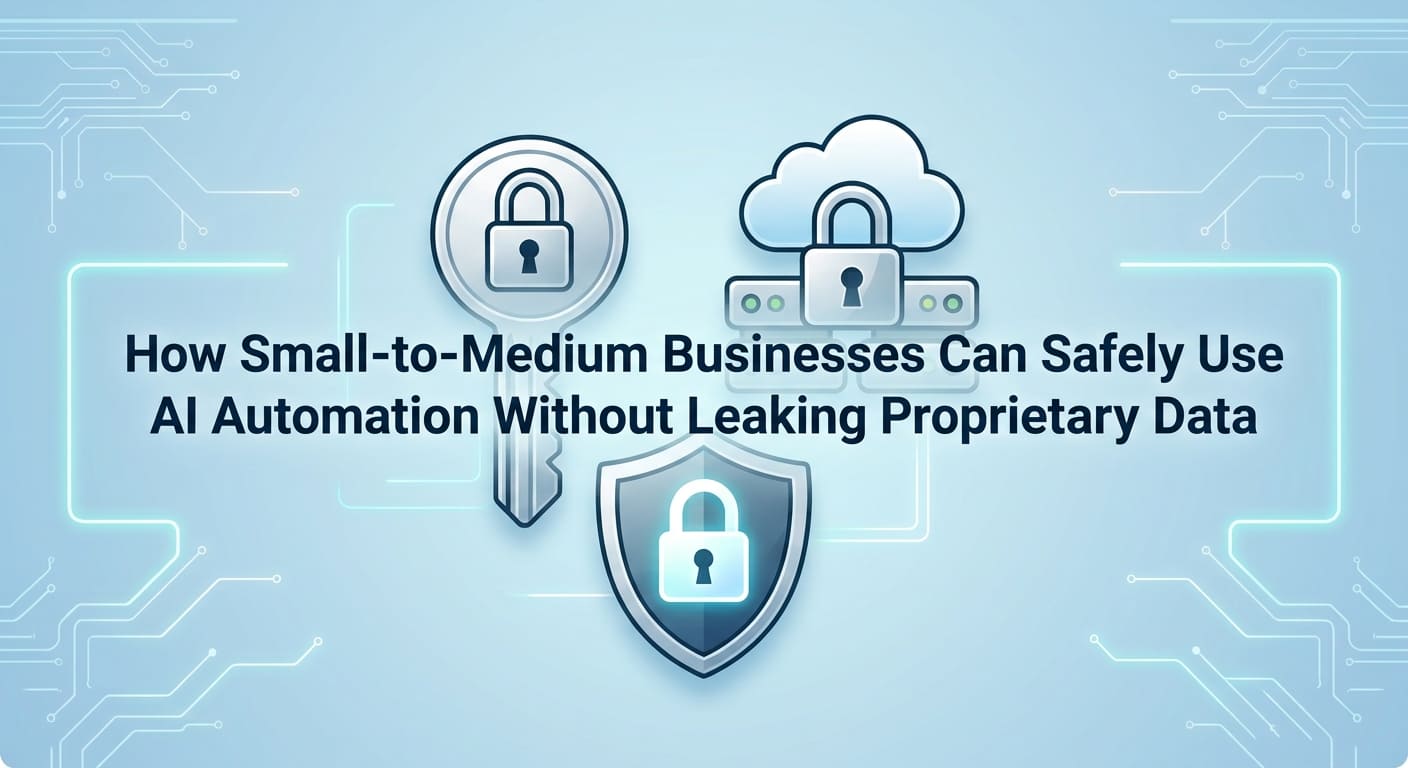
How Small-to-Medium Businesses Can Safely Use AI Automation Without Leaking Proprietary Data
Generative AI tools and automated language models offer clear efficiency gains for growing businesses. They accelerate draft creation, categorize inbound customer support requests, summarize technical documentation, and extract data from unstructured PDF invoices in seconds.
However, many companies adopt these tools recklessly. Employees paste sensitive client contracts, customer personal details, trade secrets, and internal financial records directly into public AI tools.
Public Consumer AI Path (Dangerous Data Exposure):
[ Sensitive Client Data ] ---> [ Public AI Interface ] ---> [ Saved to Public Training Logs ]

Private Enterprise AI Path (Secure System Architecture):
[ Sensitive Client Data ] ---> [ Isolated Private API ] ---> [ Direct Response (Zero Data Retained) ]
When using public-facing consumer AI tools, submitted data may be retained, logged, and used to train future iterations of public models. This creates serious data privacy, regulatory, and corporate security risks.
The 3 Core Security Vulnerabilities of Public AI Tools
- Model Training Exposure: Free public AI tools often reserve the right to ingest user prompts into their global learning sets, creating a risk that your trade secrets could surface in responses to external queries.
- Lack of Access Control Boundaries: Employees pasting internal corporate data into public accounts bypass corporate access policies, creating data governance gaps.
- Hallucinated System Outputs: Using un-scoped public models for operational tasks can produce inaccurate or fabricated information, leading to costly business errors.
Architecture for Secure, Private AI Workflows
Businesses can harness AI automation safely by building dedicated, private integration pipelines that isolate company data from public models.
 -------------------------------------------------------------------------
|                      COMPANY SECURE DATA BOUNDARY                       |
|                                                                         |
|  [ Enterprise Documents ] ---> [ Encryption & Anonymization Engine ]    |
|                                                 |                       |
|                                                 v                       |
|  [ Custom Web Portal ]     <---> [ Private API Enterprise Endpoint ]    |
|                                  (Strict Zero-Data-Retention Terms)     |
 -------------------------------------------------------------------------
1. Enterprise API Infrastructure
Access AI capability exclusively through enterprise API endpoints protected by zero-data-retention agreements. Under these agreements, vendors process language requests in memory without saving, logging, or training models on your proprietary inputs.
2. Data Anonymization Rules
Build programmatic sanitation filters before API calls go out. Automatically redact names, identification numbers, and key financial values before data reaches an external processing layer.
3. Retrieval-Augmented Generation (RAG) Architecture
Limit the AI's workspace to your verified company files. By anchoring the model's responses to a secure private database of internal documents, you eliminate hallucinations and ensure outputs remain accurate and policy-compliant.
High-Impact, Secure AI Business Use Cases
[ Inbound PDF Invoice ] ---> [ Local OCR Parser ] ---> [ Enterprise AI (Zero Retention) ]
                                                             | (Extract Structured JSON)
                                                             v
[ Instant ERP Update ] <--- [ Private DB Validation ] <------'
- Automated Document Extraction: Pulling structured vendor lines, tax figures, and line items directly out of messy PDF invoices and inserting them into accounting platforms.
- Internal Knowledge Base Search: Giving employees instant access to searchable company policies, technical manuals, and historical project files through a secure, permission-controlled interface.
- Customer Support Escalation Triage: Automatically summarizing inbound support requests and surfacing relevant solution guides to support representatives before they respond.
Building secure, private AI workflows allows your team to automate routine operational tasks while keeping client record data safe, private, and fully compliant.
Related Articles