Online Payment Platforms in Kenya: Complete 2026 Comparison for Businesses
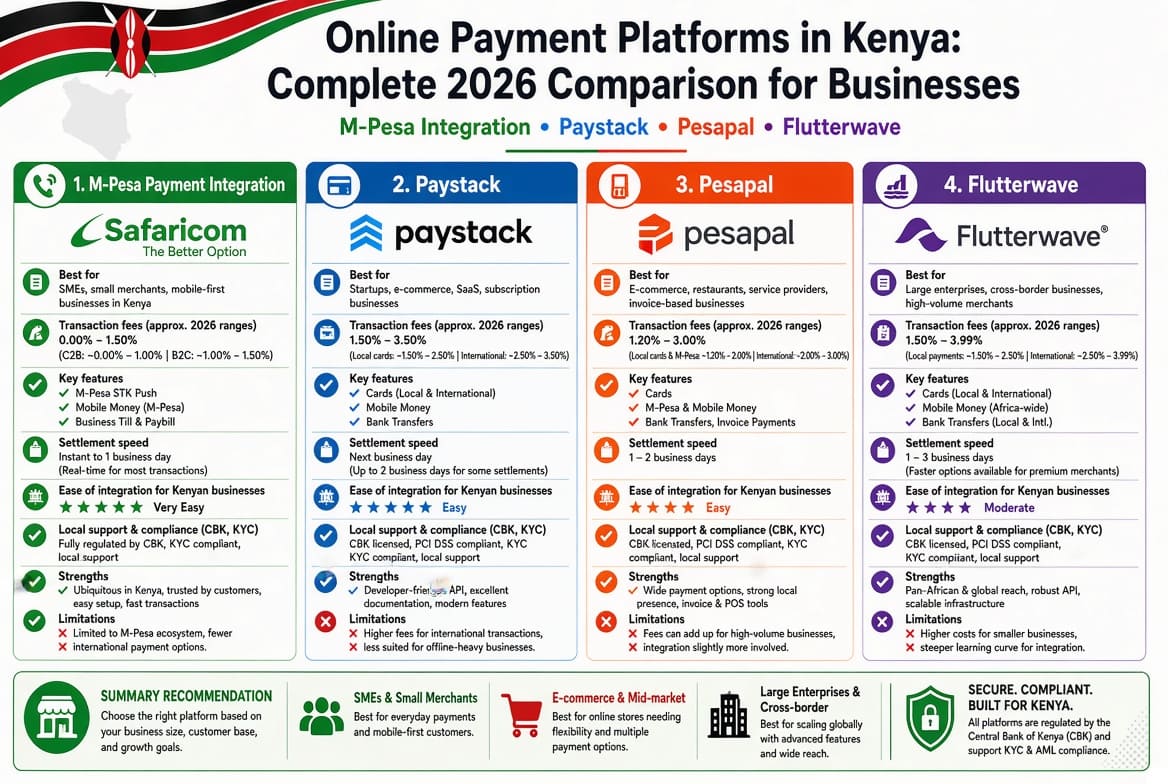
If you run an e-commerce platform, SaaS business, or digital service in Kenya, choosing how to collect money online is one of the most consequential decisions you will make. Pick the wrong payment processor, and you will leak profit margins through hidden transaction charges, watch prospective buyers abandon their carts due to buggy STK pushes, or wait days for settlements while your cash flow dries up.
The modern payment ecosystem in Kenya goes far beyond sticking a static Till number on a website. Today’s customers expect automated checkout prompts, instant payment confirmation, support for credit cards, and multi-currency options.
Choosing a payment platform is not about finding "the best overall" provider, it is about picking the right trade-off for your specific order volume, customer base, and cash flow needs. This guide breaks down the core payment platforms operating in Kenya today, comparing fees, settlement speeds, technical realities, and practical use cases.
Understanding the Core Division: Direct APIs vs. Aggregators
Before looking at individual providers, you must understand the structural difference between direct mobile money integrations and payment aggregators.
Direct M-Pesa Integration (Safaricom Daraja API)
Safaricom’s Daraja API allows you to connect your application directly to M-Pesa. When a customer initiates a payment on your site, the API communicates straight to Safaricom, triggering a native STK Push prompt on the customer’s mobile phone.
- Key Advantage: Unbeatable transaction costs. You pay standard Safaricom business rates (0.5% to 1%) without a third-party intermediary charging an additional commission. Payments hit your Paybill or Till instantly.
- The Trade-Off: M-Pesa only. If a client wants to pay with a Visa, Mastercard, or foreign bank account, a direct Daraja integration cannot process it.
Payment Aggregators
Aggregators consolidate multiple payment methods e.g. M-Pesa, Airtel Money, local bank cards, international credit cards, and digital wallets into a single checkout interface.
- Key Advantage: Multi-method acceptance out of the box. One integration handles local mobile money alongside international card payments.
- The Trade-Off: Higher transaction fees (ranging from 1.5% to 3.5% per transaction) and delayed settlement windows.
Detailed Breakdown of Top Online Payment Platforms in Kenya
Paystack: Lowest M-Pesa Fees for Local E-Commerce
Paystack has gained rapid market share among Kenyan developers and online retailers due to its developer experience and clean API architecture.
- Transaction Fees: 1.5% on M-Pesa, 2.9% on local card payments, and 3.8% on international card transactions.
- Settlement Timing: T 1 to T 2 business days.
- Best For: E-commerce businesses with high-volume M-Pesa transactions that want to minimize per-transaction fees while retaining card acceptance options.
- Platform Reality: Paystack offers the lowest published M-Pesa processing rates among the major aggregators. However, payouts take 24 to 48 hours to process, meaning it is better suited for businesses with stable working capital rather than those needing immediate daily cash liquidity.
Flutterwave: Built for Cross-Border & Pan-African Sales
Flutterwave operates extensively across Africa, making it a strong choice for businesses expanding beyond the Kenyan border.
- Transaction Fees: Roughly 2.9% on mobile money, 3.2% on local cards, and up to 4.8% on international credit cards.
- Settlement Timing: Next-day settlement for local transactions.
- Best For: Digital platforms, regional service providers, and stores selling products to customers in Nigeria, Uganda, South Africa, Europe, or North America.
- Platform Reality: Flutterwave excels at handling 30 foreign currencies and multi-country checkouts. The trade-off comes down to cost: its M-Pesa processing fee is almost double that of Paystack, and it charges a flat fee on payouts, which adds up if you withdraw funds too frequently.
Pesapal: The Established Regional Incumbent
Founded in Nairobi in 2009, Pesapal is a deeply rooted payment processor in East Africa, offering online integrations alongside physical Point of Sale (POS) card terminals.
- Transaction Fees: Ranges between 3.0% and 3.5% for mobile money and card transactions.
- Settlement Timing: 1 to 3 business days depending on payment method.
- Best For: Established brick-and-mortar businesses, hotels, travel platforms, and event ticketing operators needing unified online and offline sales tracking.
- Platform Reality: Pesapal’s primary strength lies in local brand recognition, pre-built integrations for platforms like WooCommerce, and on-the-ground support. However, its transaction percentage fee is on the higher end of the market.
IntaSend: Developer-Friendly Local Payout Engine
IntaSend is a local payment processor designed with a strong focus on both collection APIs and automated disbursements.
- Transaction Fees: 3% on M-Pesa, 3.5% on local cards, and 4.5% on international cards.
- Settlement Timing: Flexible payout schedules, including direct automated B2C/B2B disbursements to bank accounts and M-Pesa numbers.
- Best For: Freelance agencies, gig economy platforms, and businesses that need to handle both customer collections and automated vendor payouts.
- Platform Reality: While its collection fees are higher than direct APIs, IntaSend stands out for its bulk payout capabilities, allowing platforms to pay out commissions, worker wages, or supplier bills programmatically via API.
iPay Africa: Plugin-Rich Local Option
iPay Africa is one of the oldest online payment processors in Kenya, supporting mobile money, cards, and direct bank channels.
- Transaction Fees: Approximately 2.5% flat fee across transaction types.
- Settlement Timing: 24 to 48 hours.
- Best For: Educational institutions, membership portals, and standard e-commerce websites built on platforms like WordPress, OpenCart, or Magento.
- Platform Reality: iPay provides reliable turnkey plugins for popular Content Management Systems (CMS). While its standard web interface feels older than modern alternatives like Paystack, its flat-rate fee model keeps pricing predictable.
How to Select the Right Platform for Your Business Strategy
Instead of picking a provider at random, align your choice with your operational scale and business model:
If You Run a High-Volume, Kenya-Only Store
If 90% of your buyers pay using M-Pesa and you turn over more than KES 500,000 monthly, rely on direct integration via Safaricom Daraja. Saving 1.5% to 2.5% on transaction fees on every sale protects your operating margins significantly over the course of a year.
If You Want the Lowest Aggregate Costs with Card Options
If you want to accept cards without giving up too much margin on M-Pesa, Paystack provides the most competitive rate structure for growing local e-commerce stores.
If You Sell Digital Services, Courses, or Cross-Border Goods
If your buyers are located across East Africa, Nigeria, or Western markets, Flutterwave gives you the broadest multi-currency coverage and international credit card acceptance.
The Hybrid Approach Used by Top Kenyan Retailers
Many high-growth Kenyan stores do not pick just one provider. They deploy a hybrid checkout setup:
- Direct M-Pesa Daraja integration handles mobile money orders at the lowest possible cost.
- A secondary gateway (such as Paystack or Pesapal) processes credit cards and international traffic.
While maintaining two APIs requires more backend management, the savings on payment processing fees quickly justify the effort once order volumes increase.
Frequently Asked Questions
Do I need a registered business to accept payments online in Kenya?
Yes. Every reputable payment gateway operating in Kenya is bound by Central Bank of Kenya (CBK) Anti-Money Laundering (AML) regulations. You will need to submit business registration documents (CR12, Business Name Certificate, or Certificate of Incorporation), Director IDs, and a KRA PIN to complete Know Your Customer (KYC) verification.
What is the difference between a Paybill and a Till Number for website checkout?
A Till number (Buy Goods) is traditionally designed for point-of-sale retail where the customer pays a fixed amount. A Paybill account is designed for remote transactions, supporting account numbers, dynamic reference tracking, and automated callbacks through developer APIs, making it better suited for automated e-commerce web systems.
Are transaction charges passed on to the merchant or the customer?
Most payment gateway dashboards allow you to configure fee allocation. You can choose to absorb the fee within your product pricing or pass the processing surcharge directly to the customer at checkout. However, absorbing the fee generally leads to higher conversion rates and fewer abandoned carts.
Final Takeaway
Building a smooth online checkout in Kenya comes down to understanding your transaction volume and customer preferences. Evaluate your monthly payment volumes, check where your customers are located, and pick the gateway or combination of gateways that gives you the right balance of checkout speed, fee structure, and cash flow predictability.
Related Articles