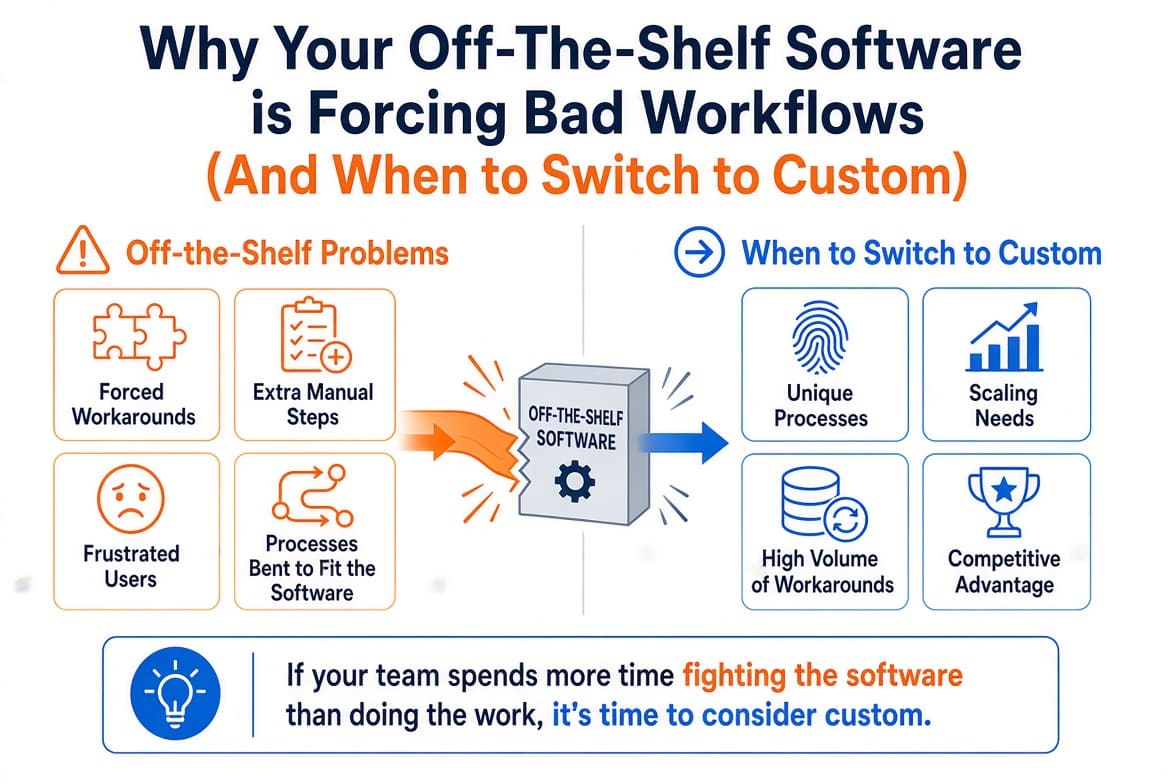
Why Your Off-The-Shelf Software is Forcing Bad Workflows (And When to Switch to Custom)
When starting a company, subscribing to off-the-shelf SaaS applications is the logical choice. Entry costs are low, setups take minutes, and you gain access to standardized functionality.
However, as your business grows, your operating model develops unique competitive advantages, specialized pricing models, specific service delivery workflows, or custom approval gates.
This is where the SaaS model breaks down. Generic software is designed to serve millions of businesses moderately well, meaning it cannot cater to your specific operational nuances. Instead of the software adapting to your operations, your staff is forced to adapt their operational workflows to fit the constraints of the software.
Standard SaaS Reality:
[Your Unique Workflow] ---> Forced into ---> [Rigid Tool A]   [Rigid Tool B]   [Rigid Tool C]
                                                 |              |              |
                                                 v              v              v
                                         [Manual Export]  [Manual Copy]  [Manual Re-key]
The Hidden Financial Friction of SaaS Stacks
While SaaS platforms advertise simple per-user pricing, the true total cost of ownership (TCO) scales aggressively as your team expands.
Cost Curve Over 5 Years: SaaS vs. Custom Software

Cost ($)
  |                                        / (SaaS TCO: Tier upgrades   Per-seat creep)
  |                                       /
  |                                 . - '
  |                           . - '
  |                     . - '   _________________ (Custom Software: Flat maintenance)
  |               . - '        /
  |         . - '             /
  |   . - '                  /
  | /                       /
   ----------------------------------------------------> Time (Years)
    Year 1                 Year 3               Year 5
- Per-Seat Tax Creep: Adding team members instantly increases monthly software expenses, penalizing your business for growing.
- Feature Gating: Key capabilities—such as SSO, advanced role-based permissions, or custom API limits—are frequently locked behind top-tier "Enterprise" plans that double or triple per-user rates.
- The "Middleware Patchwork": To connect multiple isolated SaaS tools, businesses rely on fragile third-party automation tools, secondary plugins, and custom Zapier chains. When one API updates, the entire chain breaks, requiring ongoing developer intervention.
- Spreadsheet Shadow IT: When off-the-shelf software lacks necessary fields or views, staff resort to exporting CSVs and running core operations out of unmanaged desktop spreadsheets.
The 3-Year TCO Evaluation Framework
To decide whether to keep paying subscriptions or build a dedicated custom system, evaluate total operational costs across a 36-month horizon.
3-Year SaaS TCO = Σ (Seats_t × Rate_t Addons_t Integration Fees_t) Labor Lost to Workarounds
3-Year Custom TCO = Initial Build Cost Σ (Hosting_t Maintenance_t)
5 Tipping Points: When Custom Software Wins
Switching to custom software makes economic and strategic sense when you encounter these operational tipping points:
                          Decision Tree
                                |
      -------------------------- --------------------------
     |                                                     |
Does software drive your                              Are you paying for 50  seats
core competitive advantage?                           on a rigid platform with high fees?
     |                                                     |
    YES ---> [ BUILD CUSTOM ]                             YES ---> [ BUILD CUSTOM ]
     |                                                     |
     NO                                                    NO
     |                                                     |
Does your workflow require 3                          Are you locked out of key data
different tools that don't talk?                      by API limits and exports?
     |                                                     |
    YES ---> [ BUILD CUSTOM ]                             YES ---> [ BUILD CUSTOM ]
- Your Process IS Your Competitive Advantage: If your client delivery model, pricing structure, or speed of execution sets you apart, forcing it into standard templates neutralizes your competitive edge.
- You Cross the 30-50 Seat Mark: At this scale, per-seat SaaS licensing costs often equal or exceed the capital needed to design, build, and maintain a dedicated custom platform.
- Pervasive Data Silos: When leadership cannot access clear operational reporting without manual data manipulation across multiple platforms, system consolidation becomes necessary.
- Uncontrollable API Limits: If high transaction volumes breach SaaS usage thresholds, vendor penalty fees quickly erode margins.
- Strict Security or Compliance Requirements: When storing sensitive client, financial, or healthcare data on third-party cloud infrastructure exposes you to regulatory liabilities, owning your software architecture ensures full compliance control.
Building for Long-Term Ownership
Moving to custom software is not about reinventing basic tools like corporate email or standard accounting. It is about building a dedicated software core that powers your primary operations. When you own your software code, you convert recurring operational expenses into an asset that adds equity to your corporate balance sheet.
Related Articles