How Centralized Data Pipelines Stop Inventory and Financial Leakage
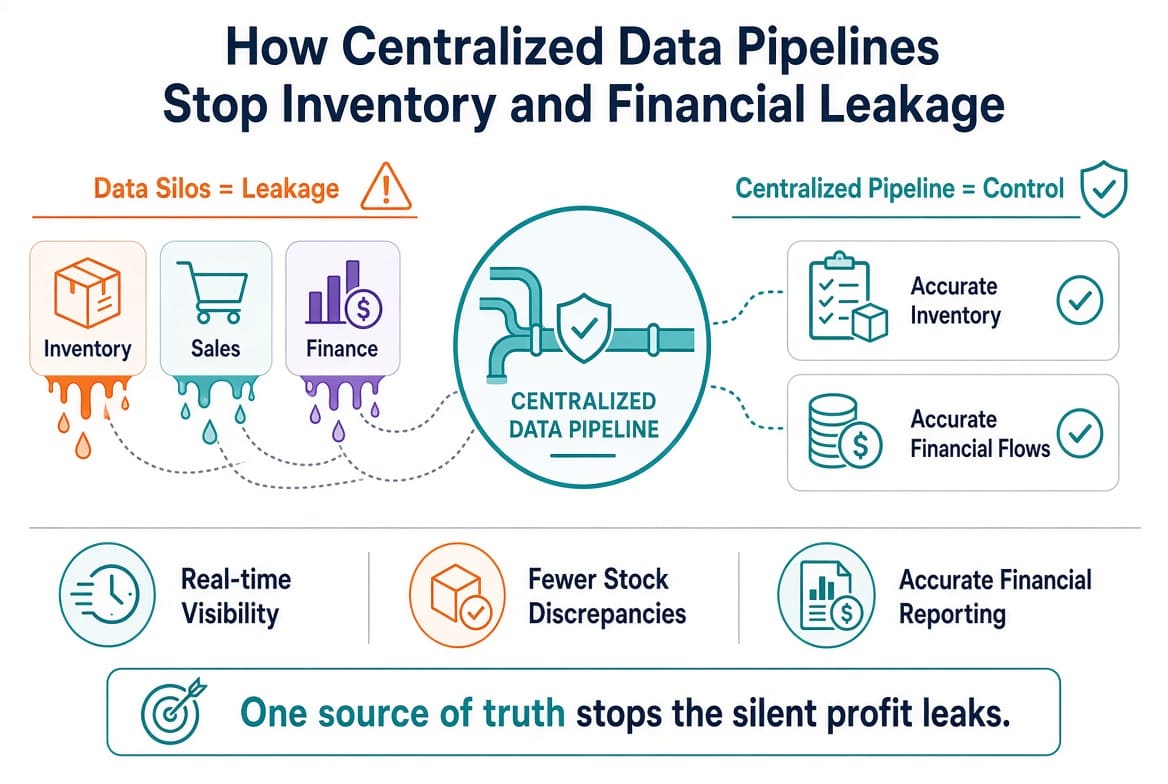
For inventory-heavy businesses, distributors, and multi-channel retailers, financial leakage rarely happens in obvious ways. It leaks through subtle operational mismatches: a sales representative promising stock that was bought an hour earlier in-store; a fulfillment worker picking an incorrect SKU due to delayed syncs; or an invoice issued with obsolete pricing tier data.
These discrepancies occur when systems operate in isolation. Your Point of Sale (POS) system records transactions independently, your warehouse runs on a separate inventory database, and your finance team reconciles transactions via end-of-month file exports.
Fragmented Architecture (High Leakage):
[ POS System ] -------\
[ E-Commerce ] --------> [ Manual CSV Export ] ---> [ Discrepancies & Stockouts ]
[ Warehouse  ] -------/

Centralized Pipeline Architecture (Zero Leakage):
[ POS System ] -------\
[ E-Commerce ] --------> [ Central Data Pipeline ] ---> [ Single Source of Truth ]
[ Warehouse  ] -------/        (Real-Time)
Without a centralized data pipeline, managers operate on delayed information, forcing them to react to operational problems after financial damage is already done.
Understanding the Financial Leakage Lifecycle
Financial leakage compounds across every stage of the supply chain when data is isolated:
[ Purchase Order ] ---> [ Receiving ] ---> [ Sales Allocation ] ---> [ Invoicing ] ---> [ Reconciliation ]
       |                     |                     |                     |                   |
   Unmapped SKU          Unrecorded             Over-committed       Incorrect Tier      Delayed Cash
    Price Shift         Damaged Stock              Inventory           Calculated         Flow Visibility
- Unmapped Supplier Price Shifts: Suppliers update cost structures, but purchase order systems fail to update automatically, leading to reduced margins on finished sales.
- Ghost Inventory: Items marked as available in online databases remain physically missing or broken in fulfillment centers, causing order cancellations and customer churn.
- Billing Variance: Disconnects between order logs and invoicing tools mean customized orders or add-on fees never get billed to the end client.
Anatomy of an Automated Data Pipeline
A modern, centralized data pipeline eliminates manual handling by acting as a live data bridge between all operational platforms.
 -----------------------------------------------------------------------
|                         DATA SOURCES                                  |
|   [ Store POS ]      [ E-Commerce API ]      [ ERP / Warehouse ]      |
 -----------------------------------------------------------------------
                                  |
                                  v
 -----------------------------------------------------------------------
|                    CENTRAL PIPELINE ENGINE                            |
|   1. Ingestion Engine  ---> Pulls data via webhooks & REST APIs       |
|   2. Validation Layer   ---> Identifies SKU mismatches & bad data   |
|   3. Sync Processor     ---> Resolves state changes in real time     |
 -----------------------------------------------------------------------
                                  |
                                  v
 -----------------------------------------------------------------------
|                       DESTINATION & DASHBOARD                         |
|   [ Real-Time Inventory Ledger ]     [ Executive Financial Views ]    |
 -----------------------------------------------------------------------
- Ingestion Layer: Captures transactional events (sales, returns, restocks) instantly using native webhooks or API polling routines.
- Validation & Transformation Layer: Normalizes data across platforms. If the warehouse logs product codes differently than the web store, the validation layer maps them correctly before updating inventory balances.
- Real-Time Ledger: Updates a central database that feeds all downstream sales channels, ensuring stock numbers remain accurate everywhere.
Quantifying the Financial ROI of Centralization
Unifying inventory and financial data delivers immediate operational gains:
- Elimination of Month-End Reconciliation Delays: Finance teams shift from spending 5 days cleaning up spreadsheets to reviewing pre-reconciled, real-time ledgers.
- Reduction in Stockout Events: Automated reorder triggers ensure fast-moving SKUs are replenished based on clear burn rates rather than manual stock counts.
- Margin Protection: Instant price-change propagation ensures that rising supply costs immediately update downstream pricing engines, preserving targeted margins.
Upgrading from Batches to Real-Time Infrastructure
Businesses do not need to discard their existing software setup to gain single-source data control. By building custom API pipelines around your current infrastructure, you can unify data management, eliminate manual entry errors, and maintain real-time control over inventory and cash flows.
Related Articles